How do plants defend themselves from root-eating creatures?
Plants: Surviving in a Dangerous World
Plants are an important food source for many creatures, including humans. Plant eaters, or herbivores, can be large mammals like cows, sheep, or horses, but most of them are actually much tinier, such as caterpillars or aphids (Figure 1). Because these tiny herbivores usually occur in large numbers, they can cause a lot of damage. Insects, for example, are the most diverse group of animals on Earth. There are around 1 million known species of insects, of which about half are herbivores. In comparison, there are only around 5,500 mammal species living on Earth. In addition to the large and small herbivores aboveground, there are many plant feeders living belowground as well. The soil is filled with many kinds of herbivores that feed on plant roots, including insect larvae, tiny worms called nematodes, and spider-like creatures called mites (Figure 1).
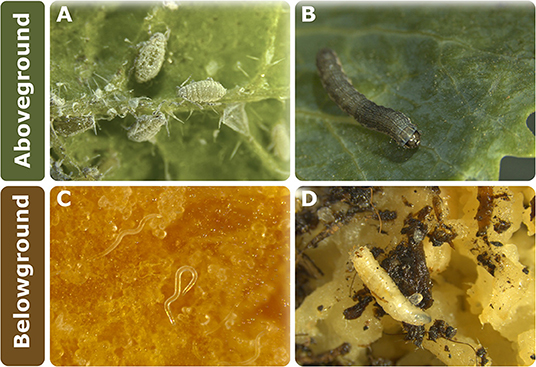 Figure 1 — Examples of aboveground and belowground herbivores. (A) Cabbage aphids, (B) the caterpillar of the beet armyworm, (C) a plant-eating nematode, and (D) the larvae of the cabbage root fly. (Photo credits: Axel Touw).
There are usually high numbers of herbivores present in the soil, just like there are aboveground. For example, there are 30,000 known nematode species, of which around 10% are plant eaters. One single female nematode produces up to 200 eggs. This means that a single plant can be attacked by thousands of nematodes at the same time. Chewing insects are another danger. They may chew through the water transport system of plant roots, which can cause the leaves to droop and the plant to die from lack of water.
How Do Plants Defend Themselves?
With so many creatures trying to attack them, you can imagine that plants have a hard time surviving. Since plants cannot flee from their attackers, they had to evolve ways of defending themselves. Plants have developed several defenses against herbivores [1]. Some plant defenses are easy to see, like the thorns of a rose, the hairs on the leaf of a stinging nettle, or the thick skin of beetroots. Other defenses, such as chemical defenses, are less visible. Each plant produces thousands of different chemicals, all involved in essential processes. Some chemicals, like sugars, provide energy to the plant. Other groups of chemicals help to defend plants against attackers. These chemical defenses can make the plant taste bad, which prevents herbivores from eating plant tissues. In some cases, the chemicals can even be toxic.
Chemical defenses can affect humans too. There are many plants that would make you feel very sick if you ate them, for example the berries of black nightshade. Some plants, such as poison ivy or hogweed, can give you a rash and even cause burns when you touch them. Most chemical defenses are not that bad, though. In fact, chances are high that you have been exposed to plant chemical defenses yourself.
We have grown to like the taste of some chemicals that plants produce. Have you ever put mustard on your hotdog or sausage, or enjoyed a nice Indian curry with mustard seeds? The sharp-bitter taste of mustard is caused by defense chemicals called glucosinolates. In the wild, glucosinolates help plants to defend themselves against insects, fungi, and bacteria. The caffeine in coffee, which helps people to wake up in the morning, is not made by coffee trees to please humans. In reality, coffee trees produce caffeine to protect their seeds—the coffee beans—from insect attacks. Caffeine not only gives coffee beans their bitter taste, but it can also paralyze or kill insects trying to feed on them.
These examples illustrate that chemical defenses are an effective way for plants to protect themselves against herbivores in their environments. Nevertheless, most plants are not completely defended by these chemicals. If you take a good look at the plants around you, you will notice that most plants show some damage, such as holes in their leaves. This is because the production of chemical defenses comes at a cost. Plants do not only have to worry about defending themselves, but they must also put energy into growth, producing flowers, and making seeds. So, the energy plants can spend on producing defenses is limited. Plants must make use of this limited amount of energy in an efficient way.
How Do Plants Defend Themselves Efficiently?
Fossils of herbivore-damaged leaves show that plants and herbivores have been living together on Earth for more than 400 million years. During this time, plants have developed several ways to produce defenses in a cost-efficient manner. One way is to produce defenses only when necessary, for example, when insects start eating them [2]. By only producing defenses when under attack, plants save energy when no dangers are present. The disadvantage of this strategy is that defense production will only begin after the herbivore starts eating. Because defense production takes time, the plant can suffer significant damage before the herbivore leaves or dies.
Another strategy is to always have some defenses at hand but in limited amounts. In this case, the plant moves most defenses to the plant parts that are most important for survival and are vulnerable to attack by herbivores [3]. This would be like defending a castle by putting the soldiers on the outer wall, where the first attack would occur and where the castle is most vulnerable. Clearly, the treasure in the castle would be well guarded too, as this is the most valuable. Aboveground, such valuable plant parts include young leaves, flowers, and seeds, which play essential roles in energy production or in producing the next generation.
Belowground, various parts of the root system also have different values. The root systems of plants like tomato or cabbage consist of three parts: the taproot, lateral roots, and fine roots (Figure 2). Lateral and fine roots help the plant take up valuable nutrients and water from the soil. The taproot is the main root that collects all the water and nutrients absorbed by the lateral and fine roots and distributes them to the aboveground parts. Simultaneously, sugars and other substances produced in the leaves move through the taproot in the other direction. The important role of the taproot in transport of nutrients and water makes it an essential part of the root system. When herbivores damage the taproot, the essential transport routes are broken, and the plant will die. In plants like beets, the taproot stores energy in the form of sugar. This is like the treasure in the castle. The taproot is therefore considered the most valuable root part and is defended the most, followed by the lateral and fine roots [4] (Figure 2).
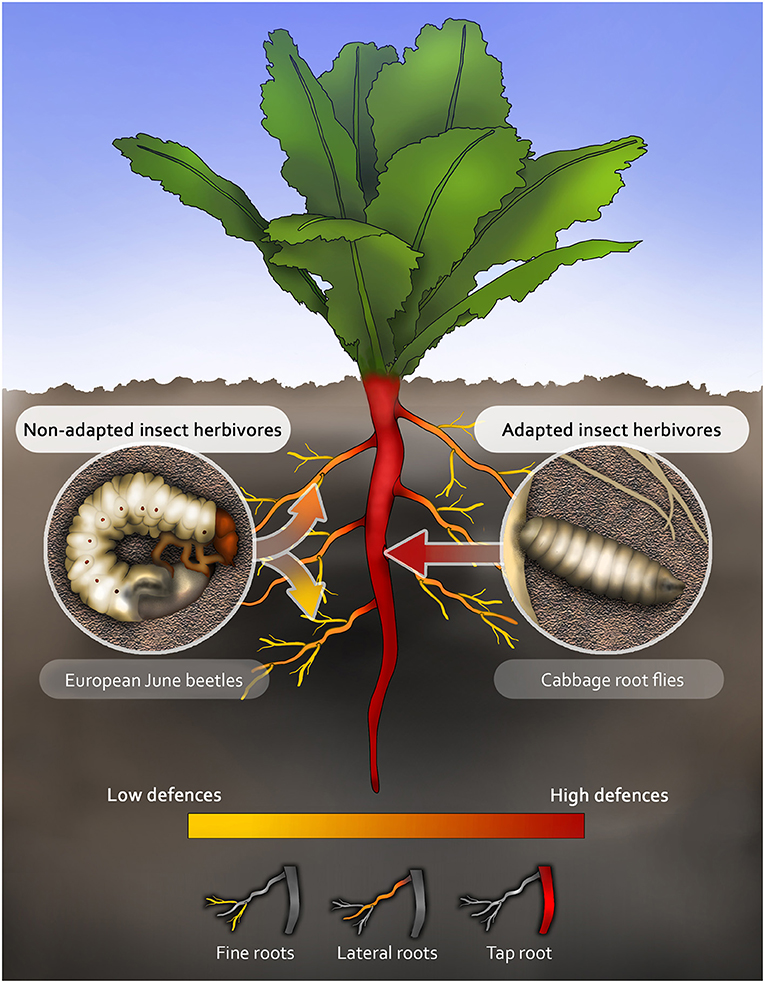 Figure 2 — The distribution of chemical defenses over a root system, and how this affects belowground herbivores. Red indicates the highest defense level in the root system and yellow indicates the lowest level. Chemical defenses are generally highest in the taproot (red), followed by the lateral roots (orange) and the fine roots (yellow). Some insect herbivores, like the cabbage root fly, can deactivate a plant’s chemical defenses and can eat the taproot where defenses are highest. Other herbivores, like the European June beetle, cannot deactivate plant defenses and therefore they eat the fine roots, where chemical defense levels are lower. (Image credit: Jennifer Gabriel).
How Do Plant Defenses Affect Soil Herbivores?
Herbivores decide which root part to eat based both on its nutritional value and on how well it is defended [5]. Most herbivores would prefer to feed on the taproot since it is the most nutritious part of the root system. However, as mentioned earlier, the taproot is also the best-defended part. Not all herbivores can overcome these chemical defenses. Some herbivores, like the larvae of the cabbage root fly, can deactivate chemical defenses and feed on the taproot [4]. Other herbivores, like the larvae of the European June beetle, cannot deal with the high defense levels in the taproot and instead eat the lateral and fine roots (Figure 2). The distribution of chemical defenses across the root system and the ability of herbivores to overcome these defenses can therefore have a strong influence on where herbivores can be found in the soil.
How Can Scientists Use This Knowledge?
The knowledge gained by studying the defense systems of plants helps us to understand how plants interact with herbivores and other animals in their environments. In addition, knowing how plants defend themselves can help us to develop more environmentally friendly ways of growing crops. Plant breeding can create new crop varieties, such as plants with nicer colors, more interesting tastes, or bigger fruits. Similarly, plant breeders can create crops that are better defended against attackers. To do so, plant breeders must understand how plants produce defenses, and which attackers those defenses are effective against. Scientists who study plant defenses using lab experiments and field studies collect this kind of information. By creating crops with better defenses, we can help farmers to reduce the amounts of chemical pesticides they use. This is good news for both human health and the health of our environment.
Glossary
Herbivore: An animal that eats plants.
Nematodes: Tiny, wormlike animals that mostly occur in the soil, but also in seas or lakes, in the intestines of animals, and even in the guts of insects.
Plant Defenses: Features of a plant that affect the behavior, growth, or survival of herbivores.
Glucosinolates: Defense substances responsible for the sharp bitter taste of mustard and wasabi. Although most humans enjoy their taste, they are toxic to most insects, nematodes and bacteria.
Taproot: Main root from which lateral roots arise. Collects water and nutrients from the rest of the root system and distributes them aboveground. In carrots and beetroots, it stores starch and nutrients.
Plant Breeding: The science of creating new plant varieties with desirable characteristics like taste, smell, color, or resistance to herbivores or certain environmental conditions like drought.
Conflict of Interest
The authors declare that the research was conducted in the absence of any commercial or financial relationships that could be construed as a potential conflict of interest.
Acknowledgments
We thank Jennifer Gabriel (iDiv, Leipzig) for her great help with the figures. We are grateful for the support from the editors of the Soil Biodiversity collection during the writing process and for the kind remarks of the young reviewers and their mentors whose advice was essential for the completion of this paper. Finally, we would like to thank the German Research Foundation (DFG) for funding our research on cabbage root flies at iDiv (DFG–FZT 118, 202548816), in collaboration with ChemBioSys (SFB 1127, 239748522).
References
- Ehrlich, P. R., and Raven, P. H. 1964. Butterflies and plants-a study in coevolution. Evolution. 18:586–608.
- Karban, R. 2020. The ecology and evolution of induced responses to herbivory and how plants perceive risk. Ecol. Entomol. 45:1–9. doi: 10.1111/een.12771
- Meldau, S., Erb, M., and Baldwin, I. T. 2012. Defence on demand: mechanisms behind optimal defence patterns. Ann. Bot. 110:1503–14. doi: 10.1093/aob/mcs212
- Tsunoda, T., Grosser, K., and van Dam, N. M. 2018. Locally and systemically induced glucosinolates follow optimal defence allocation theory upon root herbivory. Funct. Ecol. 32:2127–37. doi: 10.1111/1365-2435.13147
- Tsunoda, T., and van Dam, N. M. 2017. Root chemical traits and their roles in belowground biotic interactions. Pedobiologia (Jena). 65:58–67. doi: 10.1016/j.pedobi.2017.05.007